
 Skills: mathematical reasoning, systems thinking, Java programming, data analysis, problem-solving, analytical skills.
Description
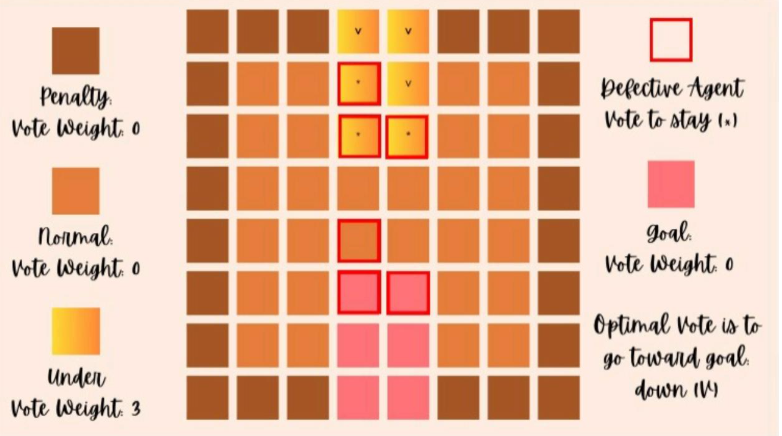
This project investigates the vulnerabilities of distributed, agent-based systems by analyzing how the placement of defective agents impacts overall system failure. Inspired by real-world distributed systems such as multi-robot teams or telecommunications networks, the simulation involves agents collaborating to move a “box” from an initial to a destination state.
Defective agents introduce disruptions, mimicking malfunctions of miscommunication. The study focuses on identifying the most effective distribution of defective agents to guarantee system failure. Key findings reveal that small, concentrated clusters of defective agents distributed along critical task paths are most effective at causing failure, highlighting the importance of these agents in maintaining system functionality. The project contributes a framework for analyzing vulnerabilities in agent-based systems and bridges theoretical findings with practical implications. It also sets the stage for future work in designing more robust systems by considering defect distributions and resilience strategies.
Thus, our project explores how the distribution of defective agents within a distributed agent-based system impacts the system’s ability to complete its task. By intentionally introducing defects in specific agents and assigning weights to each agent type’s influence on the overall group decision, we aim to identify vulnerabilities that lead to system failure.
What are the core aspects of your project?
- Agent-based Modeling: Simulating a grid environment where agents work cooperatively to achieve a goal.
- Defective Agents: Introducing agents that malfunction or miscommunicate to study their impact on system performance.
- Vulnerability Analysis: Identifying the most critical agents or areas in the system that lead to failure when disrupted.
- Practical Applications: Applying findings to improve real-world systems like telecommunications and multi-agent systems.
What are the goals/vision for this project?
The main goal is to understand how distributed systems fail when specific agents malfunction and to use this knowledge to make such systems more robust. The vision is to apply these insights across domains such as robotics, telecommunications, and automated networks to enhance reliability and efficiency.
What drove your design choices?
The design choices were driven by the need to model realistic scenarios in distributed systems where coordination and communication are crucial. Using a grid-based simulation, we could clearly visualize the impact of defective agents and systematically test different defect distributions. For example, we placed defective agents in a spaced-out manner rather than having them all concentrated at the start, since one of our other goals was to find vulnerabilities in a discrete manner.
What does your project do?
The project identifies the distribution of defective agents that maximizes the system’s failure rate. It provides a framework for pinpointing vulnerabilities in distributed systems. Although this project is academic, potential clients or industries could benefit by using it to design more fault-tolerant systems.
What are the project requirements? How did you address the requirements?
- Simulate a distributed agent-based system capable of completing a task. Addressed by building a grid environment where agents collaboratively move a box.
- Introduce defective agents and measure their impact. Addressed by programming agents with varying defect states and analyzing task completion rates.
- Provide actionable insights into system vulnerabilities. Addressed by identifying areas or agents critical to system stability and presenting these findings.
Future work. If you were to continue this project, what would be the next steps?
We would add more weight varieties to see how the surroundings and other agents could influence the box’s movement to the destination. Additionally, we would add a penalty system to measure success/failure/obstruction.
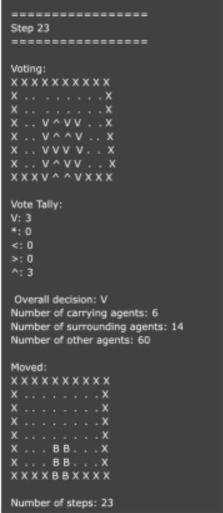
Show and describe your process to design and develop your project.
- Problem Analysis: Defined the goal of studying system vulnerabilities in distributed environments.
- System Modeling: Designed a grid-based simulation where agents coordinate to complete a task.
- Defective Agent Implementation: Programmed agents with defect states and determined how these defects impact their functionality.
- Simulation: Ran simulations with different defect distributions and analyzed the results to identify critical vulnerabilities.
- Result Visualization: Used graphical tools to showcase findings, highlighting the areas of maximum failure impact.
Talk about your challenges and achievements.
We had a bit of a challenge with JavaFX, the library we planned to use to simulate and animate the box’s movement, which took up a lot of our time. Additionally, it was a challenge to choose and decide which factors we would isolate and change, and therefore what we were truly observing, as it was a very open-ended project and there were a lot of options. We did achieve a pretty solid framework to work on and observe. We used a lot of reliable data to work on, and I think our work would serve as a foundation for future investigation as well.
Acknowledgements
We want to thank Professor Fernanda Eliott for all the advice and help she has given us throughout the development of our project, which has been truly invaluable. We would also like to thank our alumni, Rudolfo Nameera, the Vivero Fellows, the Math Tutors, and our peers for all the advice they have provided us. Thank you!
Reference: this work was inspired by Laëtitia Matignon, Guillaume J. Laurent, Nadine Le Fort-Piat. Independent reinforcement learners in cooperative Markov games: a survey regarding coordination problems.. Knowledge Engineering Review, 2012, 27 (1), pp.1-31.
