
Project Title: Cascading Failures and the Prisoner Dilemma Game (PDG), fall 2025
- This project simulates the evolutionary dynamics of cooperation and defection in a networked population using the Prisoner’s Dilemma game framework. It demonstrates how individual strategies evolve over time through imitation. (See our inspiration paper below).
Skills: Java, Graph Theory, Agent-Based Modeling, Data Visualization (GraphStream)
What was your client hoping to get out of this project?
- The project runs iterative simulations where agents play Prisoner’s Dilemma games with their neighbors, accumulate payoffs, face elimination if unsuccessful, and update strategies by imitating
successful neighbors. - Our client was hoping to learn potential cascading failure effects
resulting from networked agents playing the prisoner’s dilemma game.
What is your project about?
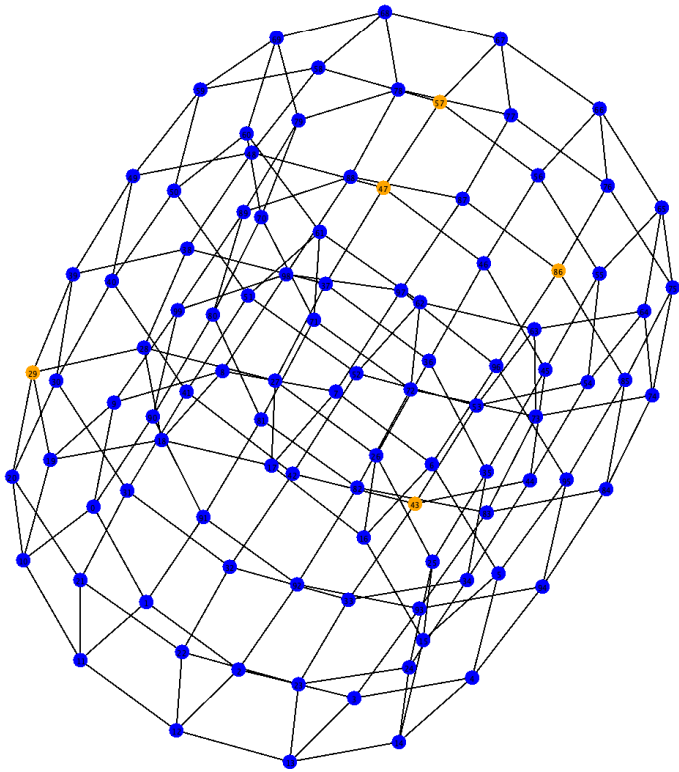 This project implements an agent-based simulation of an evolutionary Prisoner’s Dilemma game on a 2D grid network. Agents interact with their neighbors through repeated game rounds, choosing to either cooperate or defect.
- Each agent receives payoffs based on their interactions, and those failing to meet a survival threshold are eliminated from the network. Surviving agents update their strategies by imitating more successful neighbors, creating an evolutionary dynamic where cooperation and defection strategies compete for dominance.
- Our simulation features real-time visualization using GraphStream, displaying cooperators as blue nodes and defectors as orange nodes. Users can configure grid size (2D4N or 2D8N topology),
initial defector population, and number of simulation rounds. The implementation follows a three-phase game loop: payoff calculation, agent removal, and strategy updating, allowing researchers and students to observe how network structure and initial conditions influence the evolution of cooperative behavior.
What are the core aspects of your project?
- Individual agents with strategies, payoffs, and survival thresholds.
- Strategy updating through imitation of successful neighbors.
- Agent elimination based on payoff thresholds.
- Interactive display of strategy distribution and network evolution.
What are the goals/vision for this project?
- The primary goal is to provide an educational and research tool for exploring concepts in evolutionary game theory.
- The vision is to make complex concepts more accessible through
interactive simulation, allowing users to observe how cooperation can emerge and persist under different network structures and initial conditions.
What does your project do? What was your client hoping to get out of it?
- Our design choices were driven by the need for modularity and extensibility, implementing a clear separation between Agent behavior, Graph topology, Driver simulation logic, and Visualizer
rendering to enable independent development and easy feature additions. - We prioritized research fidelity by making all key parameters (payoff matrix, network topology, failure thresholds) configurable to match the academic paper’s specifications while allowing experimental flexibility.
- Finally, we emphasized user-centered design by providing comprehensive input options and real-time visualization, transforming a basic demonstration into a flexible research tool that makes complex evolutionary dynamics immediately observable and understandable.
What are the project requirements? How did you address the requirements?
- Our project required reading the paper Cascading Failures and the Emergence of Cooperation in Evolutionary-Game-Based Models of Social and Economical Networks and implementing a version of the Prisoner’s Dilemma Game described in it. We completed all requirements by developing a fully implemented Java solution.
Future work. If you were to continue this project, what would be the next steps?
- Possible next steps include adding interactive player controls by introducing a PlayerAgent that pauses the simulation for user input via a GUI, enabling real-time human participation alongside AI agents.
- Visualization could be enhanced to highlight the player’s position, neighbors, and key network metrics such as degree distribution.
- Finally, new game modes and network analysis tools would help users explore how topology and centrality influence strategy and long-term success.
Show and describe your process to design and develop your project
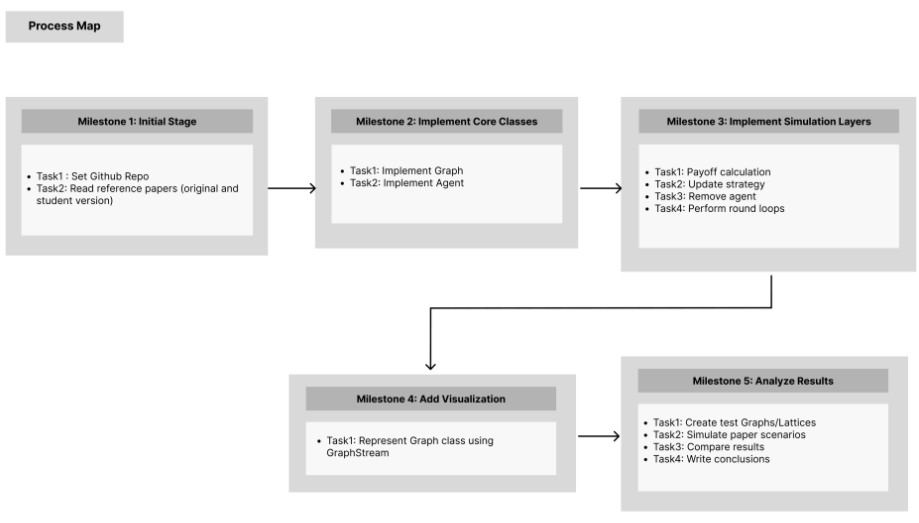
- We created a process map to describe our development plan. We started with a big-picture approach, defining the software architecture and gathering context from the reference paper.
- Then we proceeded with the core classes implementations (Agent and Graph), following OOP principles of separation of concerns.
- Next, we created a simulation/driver that connected the previous two classes via the PDG logic. Finally, we created the front-end of our project using GraphStream, adapting the graph structure to the
library’s graph, allowing us to run simulations and analyze results.
Talk about your challenges and achievements.
- A major challenge was understanding the paper’s theoretical framework, especially how evolutionary game theory concepts translate into computational models. We needed to grasp payoff matrices, imitation-based strategy updates, and the impact of network topology on cooperation before implementing the system.
- We successfully built a working game-theory simulator that
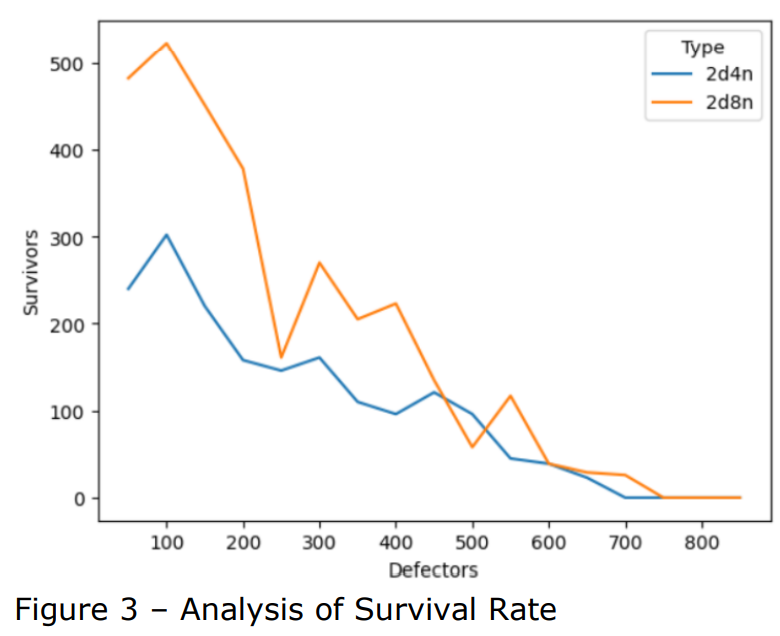 demonstrates the emergence of cooperation under specific conditions. We also developed a comprehensive test suite to ensure correctness.
 - Overall, the project delivers a flexible educational tool that bridges theoretical research with interactive, hands-on learning.
Acknowledgements and References
- We would like to thank Professor Eliott, Sasha Grigorovich, Olyvia, and other CSC-324 students for your help, support, and feedback throughout this project.
- Wang, W.-X., Lai, Y.-C., & Armbruster, D. (2011). Cascading failures and the emergence of Cooperation in evolutionary-game based models of social and economical networks. https://doi.org/10.1063/1.3621719
- Xu, Z., Chen, J., Eliott, F. (2025). Networked Independent Reinforcement Learners Playing an Evolutionary Game. In: Quintián, H., et al. Hybrid Artificial Intelligent Systems. HAIS 2024.
